Give me what you ask for and ask me for what you want. Augustine of Hippo (354-430)
29
Sep
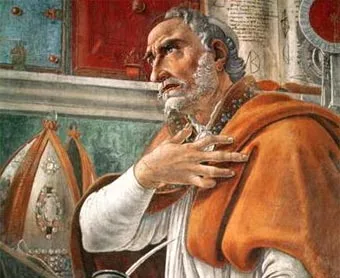
Saint Augustine
(Aurelius Augustinus or Aurelius Augustine of Hippo; Tagaste, today Suq Ahras, current Algeria, 354 – Hippo, id., 430) Latin theologian, one of the greatest figures in the history of Christian thought. Excellent painters have illustrated the life of Saint Augustine using an apocryphal scene that does not less accurately summarize and symbolize the insatiable curiosity and constant search for truth that characterized the African saint. On canvases, panels and frescoes, these artists present him accompanied by a child who, using a shell, tries to fill a hole made in the sand on the beach with seawater. They say that Saint Augustine found the boy while he was walking by the sea trying to understand the mystery of the Trinity and that, when he smilingly tried to make him see the futility of his efforts, the boy replied: “It can’t be more difficult to fill this hole with water than to unravel the mystery that boils in your head.” Saint Augustine strove to access salvation through the paths of the most absolute rationality. He suffered and went astray numerous times, because it is the task of titans to accommodate revealed truths to scientific and mathematical certainties and to achieve divinity through encyclopedic knowledge. And it is even more difficult if one has an ardent spirit that does not ignore the delights of the body. The personality of Saint Augustine of Hippo was made of iron and very hard anvils were needed to forge it. Roman, on November 13, 354. His father, named Patrick, was a pagan official in the service of the Empire. His mother, the sweet and selfless Christian Monica, later a saint, possessed an intuitive genius and educated her son in her religion, although, certainly, she did not get to baptize him. The boy, according to what he himself says in his Confessions, was irascible, arrogant and wayward, although exceptionally gifted. Romanianus, a patron and notable of the city, took charge of his studies, but Augustine, who was repelled by Greek, preferred to spend his time playing with other youngsters. It took him a while to apply himself to his studies, but he finally did so because his desire to know was even stronger than his love for distractions; After finishing grammar classes in his municipality, he studied the liberal arts in Metauro and then rhetoric in Carthage. At the age of eighteen, Augustine had his first concubine, who gave him a son whom they named Adeodatos. The excesses of this “pielago of evils” continued and increased with an excessive love for theater and other public spectacles and the commission of some robberies; This life made him renounce his mother’s religion. His first reading of the Scriptures disappointed him and accentuated his distrust of an imposed faith not founded on reason. His interests inclined him towards philosophy, and in this territory he found accommodation for some time in moderate skepticism, a doctrine that obviously could not satisfy his demands for truth. However, the fundamental fact in the life of Saint Augustine of Hippo in these years is his adherence to the Manichaean dogma; His concern for the problem of evil, which would accompany him throughout his life, was decisive in his adherence to Manichaeism, the fashionable religion at that time. The Manichaeans presented two opposite substances, one good (light) and the other bad (darkness), eternal and irreducible. It was necessary to know the good and luminous aspect that each man possesses and live in accordance with it to achieve salvation. Saint Augustine was seduced by this dualism and the easy explanation of evil and the passions it entailed, since at that time these were the central themes of his thought. The doctrine of Mani or Manes, founder of Manichaeism, was based on a radical pessimism even more than skepticism, but it unequivocally denounced the monster of dark matter, the enemy of the spirit, precisely that matter, “an ocean of evils”, that Augustine wanted to conjure in himself. Dedicated to the dissemination of this doctrine, he professed eloquence in Carthage (374-383), Rome (383) and Milan (384). For ten years, starting in 374, Augustine lived this bitter and crazy religion. He was showered with attention by the senior officials of the Manichean hierarchy and did not hesitate to proselytize among his friends. He gave himself over to ardent hymns, fasts and various abstinences and complemented all these practices with astrology studies that kept him in the illusion of having found the good path. From the year 379, however, his intelligence began to be stronger than the Manichean spell. He distanced himself from his coreligionists slowly, first in secret and then denouncing their errors in public. The flame of love for knowledge that burned within him distanced him from Manichean simplifications as it had distanced him from sterile skepticism. In 384 we find Saint Augustine of Hippo in Milan serving as a professor of oratory. There he read the classics tirelessly, delved into ancient thinkers and devoured some texts of Neoplatonic philosophy. The reading of the Neoplatonists, probably Plotinus, weakened the Manichean convictions of Saint Augustine and modified his conception of the divine essence and the nature of evil; Equally decisive in the new orientation of his thought would be the sermons of Saint Ambrose, archbishop of Milan, who started from Plotinus to demonstrate the dogmas and to whom Saint Augustine listened with delight, remaining “marveled, breathless, with his heart on fire.” Starting from the idea that “God is light, a spiritual substance on which everything depends and that depends on nothing,” Saint Augustine understood that things, being necessarily subordinated to God, derive their entire being from Him, so that evil can only be understood as a loss of good, as absence or non-being, in no case as a substance. Two years later, the conviction of having received a divine sign (reported in the eighth book of the Confessions) decided him to retire with his mother, his son and his disciples to the house of his friend Verecund, in Lombardy, where Saint Augustine wrote his first works. In 387 he had himself baptized by Saint Ambrose and definitively consecrated himself to the service of God. In Rome he lived an ecstasy shared with his mother, Monica, who died shortly after. In 388 he returned permanently to Africa. In 391 he was ordained a priest in Hippo by the elderly bishop Valerius, who entrusted him with the mission of preaching the word of God among the faithful, a task that Saint Augustine fulfilled with fervor and earned him great renown; At the same time, he fought bitterly against the heresies and schisms that threatened Catholic orthodoxy, reflected in the controversies he had with Manichaeans, Pelagians, Donatists and pagans. After the death of Valerius, towards the end of 395, Saint Augustine was appointed bishop of Hippo; From this small fishing village he would project his thoughts to the entire Western world. His former Manichean coreligionists, and also the Donatists, the Arians, the Priscillianists and many other sectarians saw their errors combated by the new champion of Christianity. He dedicated numerous sermons to the instruction of his people, wrote his famous Letters to friends, adversaries, foreigners, faithful and pagans, and served as pastor, administrator, orator and judge at the same time. At the same time he produced an enormous philosophical, moral and dogmatic work; between his books highlight the Soliloquies, the Confessions and The City of God, extraordinary testimonies of his faith and theological wisdom. When Rome fell into the hands of Alaric’s Goths (410), Christianity was accused of being responsible for the misfortunes of the empire, which provoked a fiery response from Saint Augustine, collected in The City of God, which contains a true philosophy of Christian history. During the last years of his life he witnessed the barbarian invasions of North Africa (started in 429), from which his episcopal city did not escape. In the third month of the siege of Hippo, he fell ill and died. reinforce the role that, in his eyes, divine grace plays, above that of human freedom, in the salvation of the soul. This problem is the one that has raised the most controversy, since it is related to the question of predestination, and Saint Augustine’s position contains some misunderstandings on this point. will, memory and intelligence, the soul is a simple and indivisible spiritual substance, qualities from which its immortality emerges, since death is decomposition of the parts. Such a concept would create difficulties and doubts in Saint Augustine when establishing the origin of the soul (he always rejected the Platonic notion of preexistence) and reconciling it with the dogma of original sin. If the soul was generated by the parents like the body (generationism), it was understood that original sin was transmitted to the descendants, but, being simple and indivisible, how could the soul pass to the children? And if the soul was created by God at the moment of birth (creationism), how could God create an imperfect soul, stained by original sin? For Saint Augustine, faith and reason are deeply linked: his famous aphorisms “believe to understand” and “understand to believe” (Crede ut intelligas, Intellige ut credas) mean that faith and reason, despite the primacy of the former, illuminate each other. Through sensation and reason we can come to perceive concrete things and know some necessary and universal truths, but referring to concrete, temporary phenomena. Only thanks to an illumination or additional power that God grants to the soul, to reason, can we reach higher rational knowledge, wisdom. On the other hand, correct rational discourse must necessarily lead to revealed truths. Of this In this way, reason offers us some proof of the existence of God, among which the argument of eternal truths stands out in Saint Augustine. A mathematical proposition such as, for example, the Pythagorean theorem, is necessarily true and always will be true; The foundation of such truth cannot be found in the changing evolution of the world, but in a being that is also immutable and eternal: God. God possesses all perfections in the highest degree; Augustine highlights truth and goodness among his attributes (due to the influence of the Platonic idea of good), although he establishes immutability as the attribute from which the others logically derive. Plato’s influence is again evident in the so-called exemplarism of Saint Augustine: God possesses knowledge of the essence of everything created; The ideas of each being in the divine mind are like the models or examples from which God created each of the beings. evil as non-being, as lack of being. Following the exemplarist thesis, the world and the beings that form it are good as an imitation or realization, although imperfect, of divine ideas; We cannot blame God for their shortcomings, since God gave them being, not non-being. Likewise, evil actions are acts deprived of morality; God cannot but allow them to be committed, since otherwise it would imply removing the human soul’s free will. The political ideas of Augustine of Hippo must be placed in the context of the deep crisis that the Roman Empire was going through and the accusation leveled by the pagans that Christianity was the cause of the decline of Rome. Saint Augustine responded by outlining in The City of God a philosophy of history; The word “city” must be understood in this work not as a set of streets and buildings, but as the Latin word civitas, that is, the population or inhabitants of a city. Understanding the term in this sense, for Saint Augustine the history of humanity is that of a struggle between the city of God and the earthly city, the city of good and evil. Among the inhabitants of the earthly city, “love of self to the contempt of God” prevails; in the city of God, “the love of God to the point of contempt for oneself.” Going back to the angels and Adam and Eve and descending through the Bible until he reaches Jesus Christ and his own time, Augustine of Hippo exposes the development of this constant struggle. The city of God began with the angels, and the earthly, with Cain and original sin. The history of humanity is divided into two great epochs: the first, from the fall of man to Jesus Christ, prepared the redemption; The second, from Jesus Christ to the end of the world, will fulfill and carry out the redemption, since the conflict between both cities will continue until, at the end of time, the city of God definitively triumphs. From such a broad perspective, the critical situation of the Roman Empire (in which Saint Augustine sees an instrument of God to facilitate the spread of faith) is just another moment in that struggle, and its crisis should be attributed more to the survival of paganism among citizens than to Christianization; A fully Christian Rome could become a spiritual and not merely earthly empire. Along with the core that motivates it, is found in this work its concept of family and society as positive derivations of human nature (not as a result of a pact), as well as the notion of the divine origin of the ruler’s power. Due to his vast and enduring irradiation, it can be said that Augustine of Hippo is among the most influential thinkers in the Western tradition; It is necessary to jump to Saint Thomas Aquinas (13th century) to find a philosopher of the same stature. All medieval philosophy and theology, until the 12th century, was basically Augustinian; the great themes of Saint Augustine – knowledge and love, memory and presence, wisdom – dominated Christian theology until Thomistic scholasticism. Luther recovered, transforming it, his pessimistic vision of sinful man, and the followers of Jansenius, for their part, were often inspired by Augustinus, a book in whose pages the main theses of the philosopher of Hippo were summarized.