- This event has passed.
Event Navigation
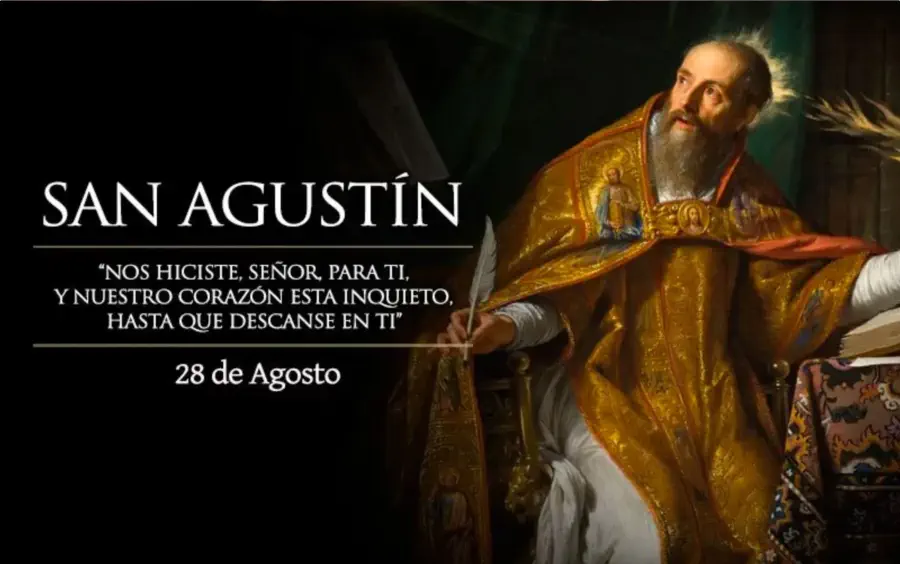
Saint Augustine, Doctor of the Church and patron of those who seek God
Every August 28, the Catholic Church celebrates Saint Augustine of Hippo, the famous bishop of antiquity who directed philosophy and theology along the route of cooperation, in such a way that the foundations of Christian doctrine were laid, as the repository of truth - that which disturbs the heart of the human being and that is fulfilled in the encounter with the divine.
Possessed of extraordinary spiritual finesse and intellectual depth, Augustine of Hippo has not only left an indelible mark on the Latin ecclesiastical tradition, but his thought has produced a decisive impact on Western science.
In Saint Augustine every soul that seeks the truth finds a safe and reliable friend. That is why he is the patron of "those who seek God."
Saint Augustine is counted among the Fathers of the Church, and is also part of the list of its Doctors. He was a brilliant orator, philosopher and theologian, author of famous texts including the Confessions and The City of God. He served the Church as a priest and bishop.
“Late I loved you”
Saint Augustine of Hippo was born on November 13, 354 in the city of Tagaste, located in North Africa, in what would today be Algeria. His parents were Patricio Aurelius, a Roman citizen, and Monica, a Christian woman of proven virtue who would achieve sainthood through her self-denial and perseverance, praying and fighting for the conversion of her husband and her son, Augustine.
From playing to “celebrate” Mass at 4 years old to entering the seminary at 13: Emilio's inspiring vocation
In his youth, Augustine devoted himself to a libertine life, given to worldly pleasures. He lived with a woman for fourteen years, with whom he had a son named Adeodato, who died very young.
Before his conversion to Christianity, he sought to gain fame and prestige: he first spent time in Carthage and then moved to Rome, the capital of the empire. Without a doubt, both his exceptional brilliance and intelligence helped him become a great orator (something like a defense lawyer today). He embraced various types of doctrines and beliefs, and for many years he was linked to the sect of the Manichaeans (variant of Gnosticism).
Things began to change when he was appointed as the emperor's orator in Milan. There he met Saint Ambrose, bishop of the city, whose testimony of wisdom and rhetorical skill impressed him like nothing had before. Providentially, Augustine was able to recognize, thanks to that holy man, both the light of Truth - with a capital letter - that he had sought, and, in contrast, the darkness in which his existence was found.
One day, when Augustine was in a garden, immersed in a deep melancholy, he heard the voice of a child telling him: “Take and read; take and read. The saint opened, at random, a Bible that he had on hand. His eyes fell on the first thing he saw: chapter 13 of Saint Paul's letter to the Romans. This one said:
«No binge eating or drunkenness; nothing of lust and debauchery… Put on the Lord Jesus Christ and do not worry about the flesh to satisfy its lusts” (Rom 13:13-14). That text touched his soul and accelerated his conversion process. At that moment he resolved to change his life according to Christ, starting by renouncing carnal pleasures and being chaste.
"Late did I love you, oh Beauty always ancient, always new. Late did I love you," writes Saint Augustine in his Confessions.
An exceptional mother: Santa Monica
In the year 387, Augustine was baptized with his son; He was 33 years old. He always considered that his conversion was late and that he wasted a good part of his life seeking the greatest in things that are pure appearance. The death of his mother, Santa Monica, that same year, left him deeply saddened.
Agustín had finally become aware of all the love and effort that his mother had put into helping him change his life and receive Christ. Never before had he perceived so clearly that his mother had been a woman of deep love for her family because she was a person full of love for God. This harsh experience, which was combined with unfathomable gratitude, would mark Agustín for the rest of his life.
Africa again: Hippo
Returning to Africa, the saint proposed to lead a life of meditation and prayer. However, God had other plans for him.
One day, while attending the Eucharist in Hippo, he was questioned by Bishop Valerius, who had already received news about his conversion. Then, Valerio told him that he urgently needed a priest to assist him in his pastoral assignment. Although he did not like the idea initially, Augustine took that question as a call from the Lord.
Thus, after the indicated time and preparation, he was ordained a priest; and, five years later, bishop. He governed the diocese of Hippo for 34 years, using his intellectual and spiritual gifts to attend to the needs of the flock that God had entrusted to him.
He fought the heresies of his time, debated currents contrary to the faith, attended several Synods of bishops in Africa and traveled constantly to preach the Gospel. He could not prevent his dedication to his episcopal work from forging great prestige within and outside the Church, especially for his lucidity, courage and wisdom.
In August 430 he became ill and on the 28th of that month he died. His body was initially buried in Hippo, but was later transferred to Pavia (Italy).
Augustine, a saint for our time
In recent decades, the Pontiffs have constantly returned to the figure of this great saint and have presented him as an example and inspiration for Christians of our time. Saint John Paul II in 1986, on the occasion of the XVI Centenary of the Conversion of Saint Augustine, published the apostolic letter Augustinum Hipponensem with the purpose of disseminating the life and work of this Doctor of the Church.
In January 2008, Pope Benedict XVI referred to him as “a man of passion and faith, of the highest intelligence and of tireless pastoral care... He left a profound mark on the cultural life of the West and the entire world.” Benedict XVI used to say that Augustine was a “good traveling companion” in his life and ministry.
In August 2013, Pope Francis, during the opening Mass of the General Chapter of the Order of Saint Augustine, also referred to him in these terms: "He is the man who makes mistakes, also takes wrong paths, sins - he is a sinner - but does not lose the restlessness of the spiritual search. And in this way he discovers that God was waiting for him; even more so, that He had never stopped seeking him first."
Source: aciprensa.com