- This event has passed.
Event Navigation
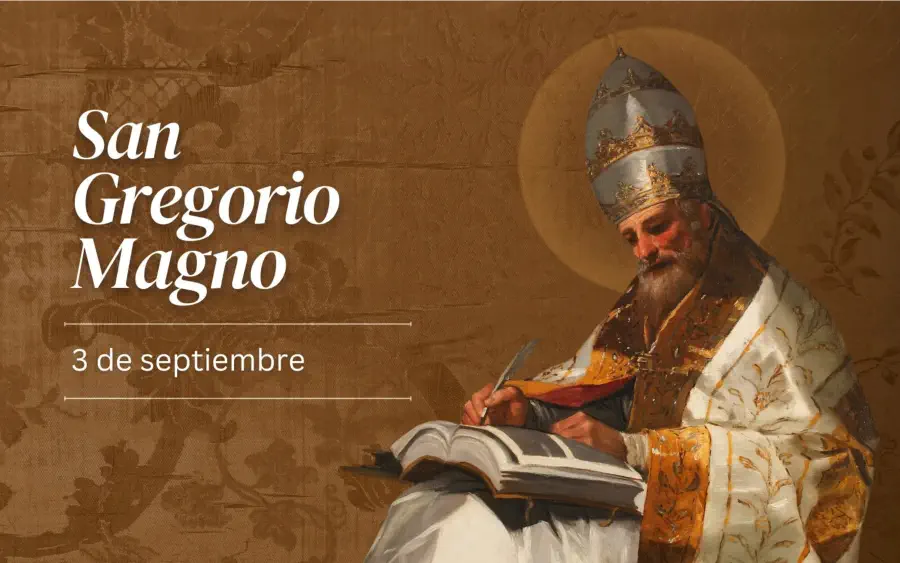
Saint Gregory the Great, pope and doctor of the Church
Every September 3, the Catholic Church celebrates Saint Gregory the Great (Pope Gregory I), monk, mystic and reformer, who redefined the figure of the papacy in the 6th century by proclaiming himself “servant of the servants of God.”
The distinctive note of Saint Gregory, whom they called “great” (from the Latin magnus, great), was its simplicity. Being head of the Church and, therefore, holding great power, He understood himself as the humble servant of all. Precisely, that is where his greatness lies, he wanted to be great in the way of Christ.
Saint Gregory was the sixty-fourth Pope of the Catholic Church; He is part of the group of the four Fathers of the Latin Church and is counted among the Doctors of the Church. Likewise, it is worth mentioning that Gregory the Great was the first monk to occupy the see of Peter.
The saint once said: “Where love exists, great things are accomplished”; and in many ways his exemplary life is testimony to this.
“Man of consensus”
Saint Gregory the Great was born in Rome in the year 540, into an ancient Roman family from which two popes had already emerged: Felix III (483-492), who is believed to have been his great-grandfather; and Agapitus I (535-536), a distant relative.
Being young, he entered the administrative career for which he had been assigned, eventually occupying the position of prefect (573); However, he abandoned it to become a monk. After this turn, upon the death of his father (575), he converted the family home into a monastery, the monastery of Saint Andrew. In a similar way, he disposed of the rest of his personal properties for the benefit of the Church.
Later, Pope Pelagius II appointed him a deacon and sent him to Constantinople as an “apocrisiary” (which today is equivalent to an apostolic nuncio). He remained there for a few years until he was called back to Rome to take up the position of papal secretary. He had to live there for hard years, as the Eternal City would suffer from natural disasters, famines due to the barbarian siege and the plague. The latter was the one that ended the life of Pope Pelagius.
In such circumstances, Gregory would be elected “Bishop of Rome and Supreme Pontiff”, thanks to the harmony that existed, at that time, between the clergy, the Roman people and the senate regarding his personal qualities.
Saint Gregory dedicated himself to the task of establishing relations of brotherhood with all possible kingdoms and governments, with the desire that the Church continue with the announcement of the Gospel throughout the world.
“Magnus”: a servant in the See of Peter (590-604)
Once in charge of the See of Peter (September 3, 590), he was concerned about the conversion of the peoples considered remote at that time, and the new civil and political organization of Europe after the fall of the Western Roman Empire.
Upon accession to the pontificate, Saint Gregory the Great, from Rome, had to watch over his city and Europe in the process of social and political reorganization. The fragmentation of the Old Continent had left the Church alone in terms of maintaining “unity”, or in any case, a certain “administrative structure”. Rome looked at Byzantium and Byzantium did not respond.
In this context, Pope Gregory negotiated with kings, nobles, ancestral houses, fallen authorities and the heads of barbarian peoples. The saint was a crucial figure in achieving a certain harmony when the people of continental Europe no longer expected the restructuring of the “lost order.”
The ties established by Saint Gregory favored the encounter between different worlds, in the heat of evangelization. In particular, it is worth mentioning his concern for the Anglo-Saxon world (England). The Pope sent missionaries to the British Isles and put Saint Augustine of Canterbury to lead that enterprise.
On the other hand, he allied himself with the monastic orders, because he saw in them the guarantee that the Church would remain solid - there is prayer there -, while, politically, he curbed the expansionist ambitions of the Franks and Lombards.
Always renew yourself in Love
The “great” Pope of the Early Middle Ages set his eyes on the center of Christian life: the encounter with God in the liturgy. One of the most important aspects of the celebration is singing, which, as is known, is a privileged form of prayer.
Gregory ordered the compilation of the music and ancient antiphons that were sung in the Church and promoted a style and musical structure conducive to the liturgy - the core of which is the Eucharist -, a legacy of what was known as Schola Cantorum. Thus he contributed to the evolution of what we today call, precisely, “Gregorian chant” in his honor.
In this task, Saint Gregory was very thorough: he managed to collect the long tradition of Christian song - born in the catacombs - and which could now vibrate in the temples for the pleasure of the human spirit. Unfortunately, a good part of that “antiphonary” (musical record) was lost, until at the beginning of the 20th century it was recovered by Pope Saint Pius X, to become the “official song of the Catholic Church.”
Echoes in the 21st century
Many other things can be written about Saint Gregory the Great, such as his intervention regarding the doctrine of “purgatory”, a topic directly committed to the idea of salvation.
It is enough for now to resort to what was said by Pope Benedict XVI, who in a general audience on May 28, 2008, referred to Saint Gregory the Great with these words: "In a disastrous, even desperate time, [Saint Gregory] knew how to create peace and give hope. This man of God shows us where the true sources of peace are and where true hope comes from; thus he becomes a guide for us today as well."
Source: aciprensa.com