- This event has passed.
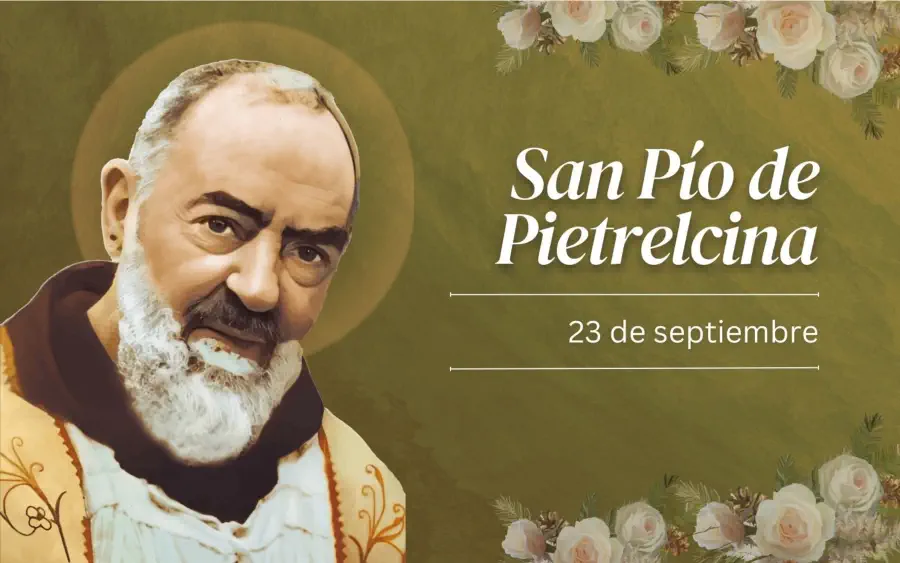
Saint Pio of Pietrelcina, the Franciscan who received the stigmata of Christ
Every September 23, the Catholic Church celebrates Saint Pio of Pietrelcina (1887-1968), whom the world affectionately calls 'Padre Pio'.
This Italian Franciscan received the stigmata of Our Lord Jesus Christ, who wanted to associate him in a special way with his Passion. Padre Pio, like Jesus, became a living offering to bear in his own flesh the pain and suffering of others, consequences of the fall of the human being. That is why, not by mistake, they call him 'the crucified one without a cross'.
Carrying the wounds of the Lord constitutes such a great gift - both in its ultimate principle and in its manifestations - that it surpasses all scientific explanation or human calculation. Perhaps the words of the saint himself will help a little to bring us closer to this mystery: “O Jesus, my sigh and my life, I ask you to make me a holy priest and a perfect victim” (Saint Pius of Pietrelcina).
By name, Pius
Francesco Forgione - Padre Pio's given name - was a friar and priest of the Order of the Minor Capuchin Brothers (O.F.M. Cap.). 'Pio' was the name that Francesco adopted when receiving the Franciscan habit, probably thinking about the beauty of its meaning ("devout", "merciful", "benign", "compassionate"), as well as honoring, at the same time, Saint Pius V, Pope to whom he professed great devotion.
A heart shaped by grace
Fra Pio was born in Pietrelcina, Campania (Italy), on May 25, 1887.
At the age of five he had his first vision: Christ presented himself to him as the Sacred Heart of Jesus. The Lord approached him and placed his hand tenderly on the head of little Francesco, who, in response, promised him that he would be his servant after the example of Saint Francis of Assisi, after whom he was named at baptism.
From that moment, the future friar would cultivate a very close relationship with Jesus and his Mother, the Virgin Mary, in daily prayer and through his visits to the local church. She, the Mother of God, would also appear to him at different times in his life.
At the age of 15, Francesco presented himself to the Franciscan convent of Morcone with the intention of being admitted. There the brothers received him with affection and consideration. That would be the place where he would live intense years of training, marked by visions of the Lord and the Mother, in which it was revealed to him that he would have to fight tough battles against the devil in the future - battles from which he emerged victorious through the work of God.
From Morcone to San Giovanni Rotondo
On August 10, 1910, the then 'Fray Pio' was ordained a priest. Shortly after, he fell ill with fever and very severe pain, which forced his superiors in Morcone to send him to Pietrelcina for recovery.
In 1916, Pius would be transferred to the monastery of San Giovanni Rotondo. The Provincial Father, seeing that his health had improved significantly, decided to let him remain in that convent, behind whose walls the saint received the grace of the stigmata.
Multiple stories about this were woven together over the years - most of them distorted and unfair - and Saint Pius had to bear many crosses: incomprehension, public condemnation, hatred and even envy.
The story about the stigmata
"It was the morning of September 20, 1918. I was in the choir doing the prayer of thanksgiving at the Mass... Christ appeared to me bleeding everywhere. From his wounded body rays of light came out that looked more like arrows that hurt my feet, hands and side," Padre Pio told his spiritual director at the time.
"When I came to, I found myself on the ground and wounded. My hands, feet and side were bleeding and hurt until I lost all the strength to get up. I felt like I was dying, and I would have died if the Lord had not come to support my heart that I felt beating strongly in my chest. On all fours I crawled to the cell. I lay down and prayed, I looked at my wounds again and cried, singing hymns of gratitude to God," he continued. Father.
These brief parts of the story are more than impressive. However, having borne the wounds of Christ and suffered in a manner similar to Him did not push him to ostentation - as often happens with false witnesses. Quite the opposite: they made Padre Pio a unique person. The holiness that he incarnated did not lie in the prodigy, nor was it the case of Saint Francis of Assisi - the first saint to receive the stigmata. In the heart of the humble priest there was no room - despite the frenzy because of the miracle - to seek celebrity, fame, or the “enigma.”
Holiness is a question that is only possible in the order of charity.
an ordinary man
Padre Pio was fundamentally an “ordinary” saint, in the sense that, like every mortal, he had to fight the same spiritual struggles that we all go through: Pius was a man like any other, with defects, frailties and virtues.
So what was the difference? The answer may seem excessively simple: Padre Pio only wanted to repay love with love. Whoever lives consistently trying this, sooner or later, will achieve the “extraordinary.”
Because of charity, Padre Pio received the extraordinary ability to understand the human soul, to the point that he read on several occasions the hearts and consciences of those who approached him. That ability to penetrate and uncover the interior that one wants to hide helped him to be a unique confessor. Abundant testimonies corroborate that those who came to him to confess found the merciful face of God, who unconditionally welcomes the sinner. And in front of which all truth is exposed.
Just as Padre Pio became famous for having received the stigmata of Jesus Christ on his hands, feet and side, so he also became famous for having worked miracles during his life.
The poor
Padre Pio was a man concerned about those in need. On January 9, 1940, he caused one of his holy revolutions. He convinced his great friends to found a hospital, an undertaking considered 'impossible'.
It should be one of those hospitals that serves to heal “the bodies and also the souls” of the needy people in its region. The project took a few years, but it was finally inaugurated on May 5, 1956, with the name “Relief of Suffering House.”
Pope John Paul II
Saint John Paul II openly expressed that he had a special admiration for Padre Pio.
There are many testimonies that suggest that it was the holy Franciscan friar who, in the middle of confession, predicted to the person in front of him, Karol Wojtyla, that he would become Pope.
According to a letter sent by the Pilgrim Pope to the friars of San Giovanni Rotondo about three years before his death, Wojtyla, while still a young priest, met Padre Pio and confessed to him.
The content of the letter was made public - in accordance with the will of the Pontiff - after his death in 2005. In it, John Paul II called Padre Pio "generous dispenser of divine grace, always available to all." He also describes him as someone full of receptivity and spiritual wisdom, especially in the dispensation of the sacrament of penance. The Polish Pope thus attested to why large crowds of faithful came to the convent of San Giovanni Rotondo to look for Padre Pio.
What John Paul II expressed was in complete contrast to those circles in which it was stated that Padre Pio was an excessively rigorous confessor, who treated pilgrims harshly. In aid of this comes the certainty that these always returned to see the Father, and on top of that they summoned others.
Thanks to the saint of Pietrelcina, many became more aware of the seriousness of their sins, and, thanks to that, they were able to genuinely repent.
Epilogue: prayer and charity
Padre Pio left for the Father's House on September 23, 1968, after several hours of agony, in which he repeated in a weak voice “Jesus, Mary!”
During the ceremony of his canonization, celebrated on June 16, 2002, Saint John Paul II forcefully stated: “Prayer and charity, this is a highly concrete synthesis of the teaching of Padre Pio, which today is once again proposed to everyone.”
Source: aciprensa.com