- This event has passed.
Event Navigation
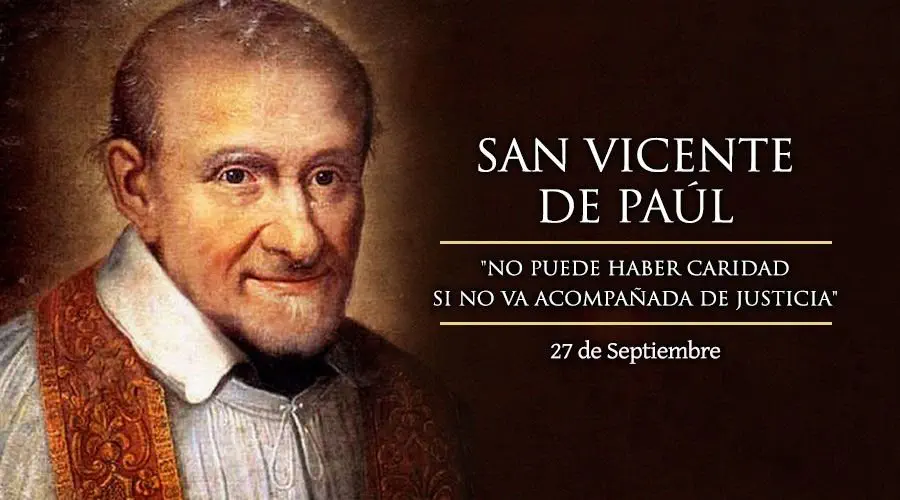
Saint Vincent de Paul, priest, founder of the Congregation of the Mission and the Daughters of Charity, patron of all Charity Associations
"Let us love God, my brothers, but let us love him at our own expense, with the work of our arms, with the sweat of our face."
In a small town in Gascony, France, in 1581, Vincent de Paul was born into a peasant family. Although he spent his adolescence in the fields, his fine intelligence was noticed by a benefactor who offered him the opportunity to study, so much so that in 1600, at only 19 years of age, he was ordained a priest, while he obtained a degree in theology in 1604. He opened a private school but incurred many debts; Furthermore, during a boat trip from Marseille to Narbonne, his ship was attacked by pirates; Vincent was taken prisoner and sold into slavery in Tunisia. He managed to regain his freedom and return to France two years later thanks to his third owner, who little by little had converted to Christianity.
From tutor of the rich to parish priest of the poor
In 1612 Vincent was finally entrusted with the parish of Clichy, on the outskirts of Paris. This mission allowed him to meet Cardinal Pierre de Bérulle, who would be his spiritual father for a long time. He then began his activity as a catechist, but the following year he became a tutor for the children of the Marquises of Gondi, where he remained for four years. It was here that Vicente first realized the enormous gap between rich and poor, not only from a material and social point of view, but also from a cultural and moral one. His concerns were shared by the Marchioness Gondi, who made a large sum of money available to him to establish a five-year preaching mission among the peasants of her lands. Vincent, however, found no other priests to support him in this task and gave up, temporarily leaving the castle and going to work in the rural parish of Chatillon-le-Dombez. But here the contact with the miseries of the peasants shook him even more deeply.
The "discovery" of charity that moves the world
As his first act as a parish priest, Vicente took care of a sick family that had nothing to eat: he then organized a chain of solidarity among the parishioners that was very successful. However, he realized that once the alms had run out, the family would have sunk back into destitution: therefore, a more efficient, long-term organization was needed to serve this and other needy families in the area. On August 20, 1617, the first cell of Vincentian Charity came to life. To take care of this, as the society of that time imposed, there will only be women called "Servants of the poor." The association grew exponentially and in record time obtained the approval of the Bishop of Lyon. Vincent understood that it was love that moved all things and he chose to dedicate himself entirely to this: transmitting to others at least some of that love with which he felt deeply loved by God.
Ladies and Daughters: Families of Charity
Vicente returned to the castle of Gondi, but this time to deal only with the human and material promotion of the peasants. Then he moved to Paris, because it was in the cities where the social differences between those who had everything and those who had nothing were greatest: he felt that was where he had to intervene. In the capital, many noble women, eager to do charity and contribute financially to his works, sought out "Monsieur Vincent": thus the Ladies of Charity were born, among whom was even the future Queen of Poland. The most important work they managed to accomplish in 1634 was the opening of a city hospital. But the Ladies were not enough: both in number and because, given their social position, they could not take charge of the most humble occupations. In 1633, then, Vincent founded a very innovative female Congregation for the time: the Daughters of Charity, who would not be "nuns", separated from the world and dedicated to contemplation, but "sisters", sisters of the least, who would live alongside them in the world and care for them daily. In short, for the first time consecrated women would also participate in the active apostolate. Even today the Daughters of Charity are the largest female religious family in the Church.
The formation of the clergy and the "Lazarists"
But Vincent's work was not limited to the new nuns. Already in 1618 he had begun to preach the Word of God in the towns and many priests had joined him: a new community was born, which enjoyed the financial support of the Gondi family; Among the rules were the need to live together, to renounce the most coveted ecclesiastical offices, to take care of the spiritual care of prisoners and to teach catechism. It was the Congregation of the Mission, later called the Congregation of the Lazarists, because of the convent of San Lázaro where it was located. Vincent realized that the ignorance of the peasants was also often associated with poor preparation of the priests who had to take care of them: that is why he also committed himself to the formation of the clergy, promoting spiritual exercises and giving life to "Tuesday conferences": meetings in which priests recounted their experiences of active apostolate and motivated each other to be faithful to their vocation to holiness.
Monsieur Vincent's "Regulae"
Vincent died in Paris on September 27, 1660 at the age of 79. He did not leave any written work: his masterpiece was Charity. A charity that is a universal and open love that does not put barriers or distinctions between what is offered to God and what is offered to our neighbor. A spirituality, the Vincentian one, that is based on the double discovery of Christ and the poor, and on the complementarity of prayer and action, a commitment that is in the world and for the world and that takes shape both in evangelization and in human promotion. His religious children follow the Vincentian spirituality described in the “Regulae”. They embody the characteristics of the Vincentian spirit through simplicity, humility, meekness, mortification and zeal for the salvation of souls. Saint Vincent de Paul was canonized by Clement XII in 1737, while in 1885 Pope Leo XIII proclaimed him patron of all Catholic Charity Associations.
Source: vaticannews.va